Overview
Our Mission
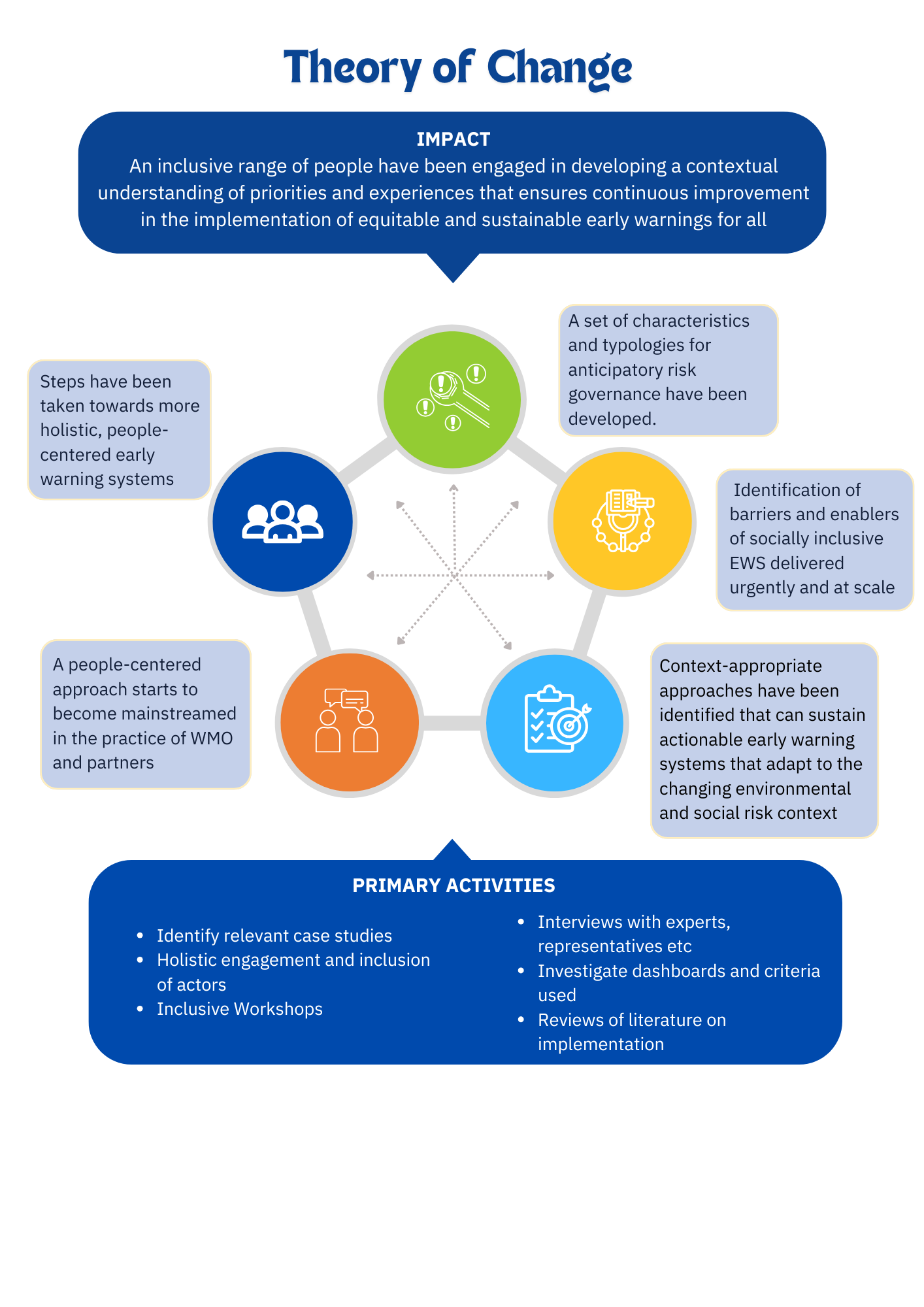
Engage an inclusive range of people in developing a contextual understanding of priorities and experiences that ensure continuous improvement in the implementation of equitable and sustainable early warning systems for all.
Our Research Questions
Question 1: How can we involve and identify the needs of an inclusive range of people to be effectively and adequately involved in the design, planning, and implementation and evaluation of early warning systems?
Question 2: What are the barriers and enablers to design socially inclusive early warning systems, delivered urgently and at scale inter-alia including multi-level governance, resources (human and financial), spectrum of impactful events, culture, context, trust, etc.
Question 3: How can context-appropriate EW systems be optimised, sustained, and adapted to evolving weather and climate-induced risks and socio-economic structural dynamics?
Our Objectives
Objective 1: To develop a set of characteristics and typologies for anticipatory risk governance for sustainable and equitable early warning systems for all.
Objective 2: To identify barriers and enablers of socially inclusive early warning systems, delivered urgently and at scale.
Objective 3: To identify context-appropriate approaches that can sustain actionable early warning systems that adapt to reflect the changing environmental and social risk context
Why PEOPLE Matters
The World Meteorological Organization’s Early Warnings for All (EW4All) initiative aims to ensure that everyone is protected by early warning systems (EWS) by 2027. However, many countries, particularly across Africa, the Pacific, and Latin America lack the infrastructure, observational data, and capacity needed to deliver timely, multi-hazard warnings.
As climate hazards become more frequent and severe, the urgency to improve how warnings are designed, delivered, and understood is growing. The IPCC’s Sixth Assessment Report (2022) emphasizes that effective early warnings require more than just accurate forecasts, they must also involve communities and stakeholders in meaningful ways.
Local knowledge, trust, and social context play a critical role in how warnings are received and acted upon. Studies show that even nearby communities can respond very differently to the same warning, depending on cultural factors, prior experiences, and local governance.
The PEOPLE Project responds to this gap by promoting people-centred approaches to early warning. It supports the co-design of systems with those most affected, focusing on inclusion, equity, and practical usability. Through cross-sector collaboration and ongoing learning, the project aims to build early warning systems that are not only scientifically robust, but also trusted, locally relevant, and responsive to real-world needs.
To learn more access our project implementation plan here.
Copyright © 2026 WMO- PEOPLE | Department of Meteorology, University of Dhaka | Powered by Phoenix Software